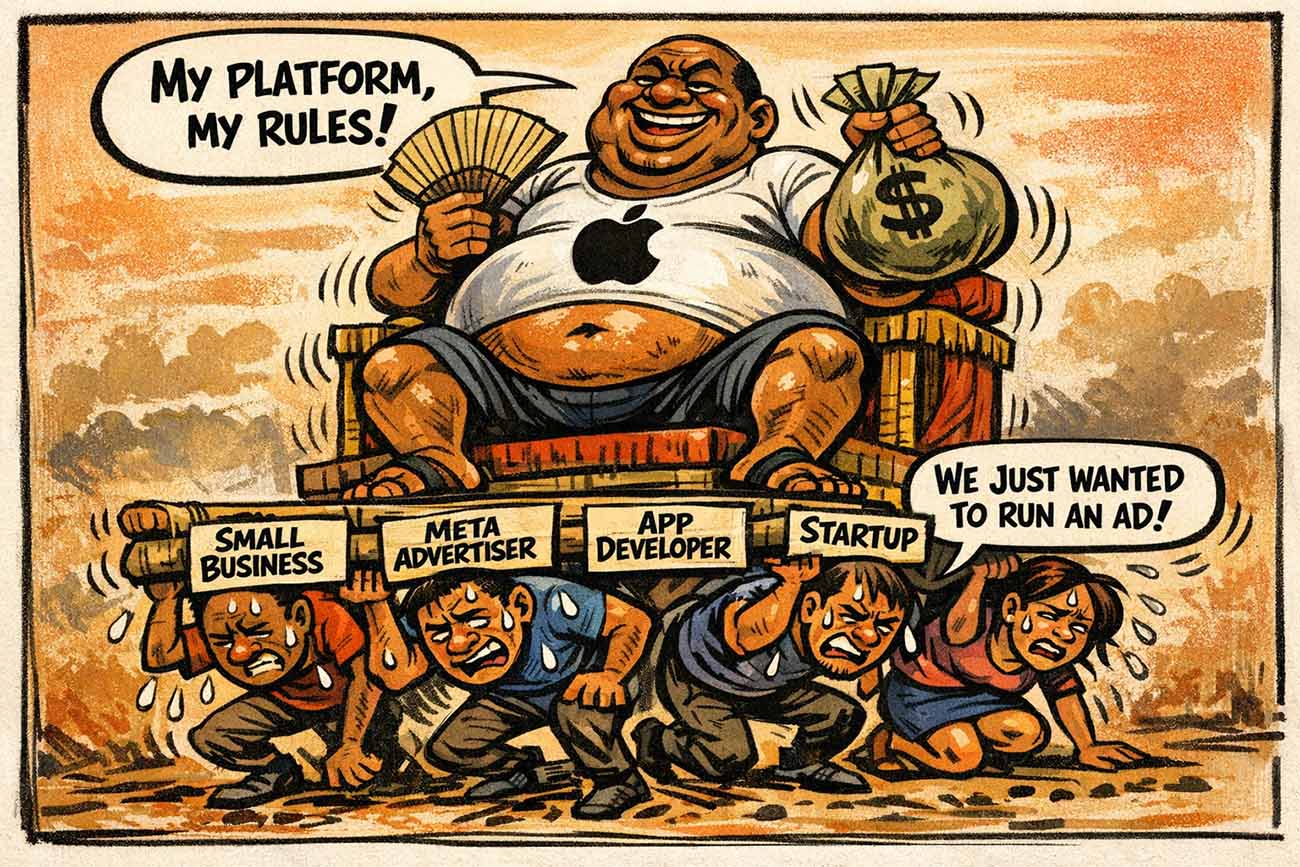
Let's be clear about what's happening here.
Apple — a company sitting on a $3 trillion market cap, generating nearly $100 billion a year from its Services division alone — decided that when a small business owner in Birmingham or Brooklyn opens Instagram on their iPhone and pays £20 to boost a post, Apple should get 30% of that.
Not for building the ad. Not for running the campaign. Not for any creative or strategic input whatsoever.
Just for being the gatekeeper.
That's not a business model. That's a toll booth masquerading as an ecosystem.
What Actually Happened
In February 2024, Meta announced it would begin passing Apple's 30% in-app purchase fee directly on to advertisers using the Facebook and Instagram iOS apps to boost posts. By July 2024, the policy had gone global.
The framing from Meta was careful — they positioned it as Apple's charge, not theirs. And technically, they're right. Apple's App Store Review Guidelines require that purchases of digital goods and services made inside iOS apps must go through Apple's in-app purchase system. Boosted posts — where you pay to increase the reach of your content — are classified as digital services. So Apple's cut applies.
Meta had reportedly been operating outside these guidelines for years, effectively skirting the fee. When Apple tightened enforcement, Meta faced a binary choice: comply, or remove the boost feature from its apps entirely. They chose compliance, and passed the cost downstream.
The result? Millions of small businesses, many of whom manage their advertising from their iPhones, suddenly found their ad costs inflated by 30% overnight — not because ad performance changed, not because Meta's platform got more expensive to operate, but because Apple said so.
Apple's Defence Doesn't Hold Up Under Scrutiny
Apple's official line is straightforward: the App Store has always required in-app purchases for digital services. They also point out that advertisers can use the Meta Ads Manager app on iOS — which is designed specifically for ad campaign management — and avoid the fee entirely. Or they can just use the web.
On the surface, that sounds reasonable.
But it falls apart the moment you examine it honestly.
First, if this was always the rule, why was Meta allowed to operate outside it for years while other developers were hit immediately? The inconsistent enforcement raises serious questions about whether this is principled policy or selective pressure.
Second, telling small business owners to "just use the web" is the kind of advice that only makes sense if you've never actually run a business on the ground. The reality is that millions of people manage their entire business operations from their smartphones. Asking them to switch devices or browser tabs to avoid a fee that didn't exist yesterday is a friction cost that disproportionately hits the smallest, least technically sophisticated operators.
Third — and this is the critical one — Apple didn't invent Meta's advertising platform. They didn't build the targeting algorithm, the creative tools, the audience data infrastructure, or any of the value that makes a Meta ad worth running in the first place. The 30% fee exists not because Apple contributed 30% of the value, but because Apple controls the device.
That's not innovation. That's rent-seeking.
The Courts Are Starting to Agree
The Apple tax isn't just a talking point. It's been tested in courtrooms, and the findings are damning.
The Epic Games v. Apple case — which began in 2020 when Epic deliberately bypassed Apple's payment system in Fortnite — produced a federal judge ruling that Apple's 30% commission may be "unjustified" relative to the value they actually provide. The court found that Apple's operating margins on the App Store are "supracompetitive" — a legal term that essentially means above what a genuinely competitive market would allow.
When the court issued an injunction requiring Apple to allow developers to link users to external payment options, Apple's response was breathtaking in its audacity. Rather than comply in good faith, they introduced a new 27% commission on external purchases — a fee that, when combined with transaction processing costs, actually made external payments more expensive than using Apple's system. They also added friction-inducing warning screens to discourage users from clicking external links at all.
In April 2025, Judge Yvonne Gonzalez Rogers found that Apple had "willfully" violated her injunction. She described their behaviour as a "cover-up," accused them of choosing "the most anticompetitive option" at every decision point, and referred Apple and one of its executives to federal prosecutors for possible criminal contempt proceedings. That's not a regulatory slap on the wrist. That's a federal judge saying this company deliberately deceived the court to protect billions in revenue.
Meanwhile, in Europe, the EU fined Apple €500 million for failing to comply with the Digital Markets Act — specifically for blocking developers from informing users about cheaper options outside the App Store.
The pattern across these cases is consistent: Apple uses its control of the iOS platform not as a service, but as leverage. The fee isn't about the cost of running the App Store. It's about maintaining a revenue stream that courts have found difficult to justify on any grounds other than monopoly power.
Who This Actually Hurts
Here's what gets lost in the big-company framing of this story.
When Apple and Meta go to war, it makes headlines. Billion-dollar companies trading statements through press releases is content. What doesn't make headlines is the florist in Manchester who spends £50 a month boosting posts on Instagram to keep bookings coming in, and suddenly finds out she's actually been paying £65 — with the extra £15 going to a company that had nothing to do with her business.
Or the personal trainer in Lagos who just started building his client base through Facebook, running ads on a tight budget, and discovers his cost-per-acquisition has just jumped by 30% with no change to his targeting or creative.
Meta itself claimed that millions of small businesses use boosted posts. These aren't sophisticated advertisers with agency relationships and media budgets. They're founders, sole traders, and micro-businesses who discovered that social media advertising was finally accessible to them — and are now being taxed on that accessibility by a company that built the pipe, not the water.
The irony is that Apple positions itself as a company that values privacy and user experience. But when it comes to the economic experience of small business owners who happen to use iPhones, the interest is rather more selective.
Meta Isn't Entirely Innocent Either
Let's be honest about this too.
Meta had options. They could have absorbed the 30% hit entirely — it would have dented margins, but for a company generating tens of billions in annual ad revenue, it would not have been existential. Instead, they chose to weaponise the fee, passing it directly to advertisers while loudly framing Apple as the villain.
Was that a principled stand against anti-competitive behaviour? Or was it a calculated move to use small business owners as proxies in a corporate power struggle — generating the kind of advertiser outrage that helps Meta's broader lobbying effort against Apple's App Store policies?
Probably both. That's how it works at this level. The cause can be legitimate and the motive can be self-interested at the same time. But Meta's hands aren't clean here. They had choices, and they chose the one that cost their customers the most and bought them the most political cover.
What You Should Actually Do
If you're running Meta ads and managing them through iOS, the practical workaround is simple: don't.
Use the desktop browser at facebook.com or instagram.com to add funds to your ad account and manage your boosts. Alternatively, the Meta Ads Manager app on iOS operates under different guidelines and doesn't apply the 30% fee in the same way. The fee only triggers when you're processing payment through Apple's in-app purchase system.
Longer term, this situation is a useful reminder of what platform dependency actually costs. If your entire marketing operation runs through a single company's app on a single company's device, you're exposed to whatever those two companies decide to do next. Diversifying your advertising spend — whether that's Google, TikTok, email, SEO, or building owned audiences — isn't just strategy. It's risk management.
And if you're a UK-based business, it's worth knowing that the EU's Digital Markets Act has forced some changes to how Apple operates in Europe that don't yet apply here post-Brexit. That regulatory divergence may become more significant as the landscape evolves.
The Bigger Picture
What's actually at stake in the Apple App Store debate isn't just the 30% fee. It's the question of who gets to define the rules of digital commerce — and who pays when those rules serve the gatekeeper rather than the market.
Apple built an extraordinary platform. The iPhone genuinely changed what's possible for small businesses, creators, and entrepreneurs around the world. None of that is in dispute. But the fee structure that sits on top of it wasn't built to reflect the cost of providing that platform. It was built to extract value from it.
The courts have increasingly recognised this. The EU has acted on it. And the slow unravelling of Apple's in-app purchase monopoly — through Epic's litigation, Spotify's external payment links, and the broader pushback from developers — suggests that the 30% era is already ending, even if the ending is messier than it should be.
For small business owners, the lesson isn't complicated: understand the platforms you depend on, know who they really work for, and build your business in ways that give you as much control as possible over your own costs and customer relationships.
The Apple tax is real. The best response is to stop paying it.
Mike Adeleye is a digital strategist, developer, and founder of IlanoShop — a UK-built e-commerce platform built around transparency and zero transaction fees. He writes about the intersection of technology, business, and power at mikeadeleye.dev.